Chapter 13: Space on the carriageway; signalling a stationary vehicle; motorways and main extra-urban roads; carrying passengers; loading; vehicle plates; towing vehicles and broken-down vehicles; towing trailers
Ingombro della carreggiata; segnalazione di veicolo fermo; norme sulla circolazione in autostrada e strade extraurbane principali; trasporto di persone; carico dei veicoli; pannelli sui veicoli; traino dei veicoli e dei veicoli in avaria; traino dei rimorchi
Chapter 13 of the official list (Ingombro della carreggiata; segnalazione di veicolo fermo; norme sulla circolazione in autostrada e strade extraurbane principali; trasporto di persone; carico dei veicoli; pannelli sui veicoli; traino dei veicoli e dei veicoli in avaria; traino dei rimorchi) has 318 true-or-false questions. Here are 12 of them in Italian, with the English translation and the answer.
Practise all 318 questions of this chapter (after unlocking)Start free · launch price €9.90 once (€14.90 from 1 January 2027)
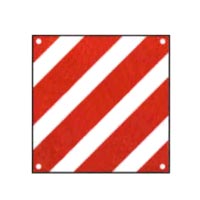
Il pannello raffigurato deve essere messo all'estremità del carico che sporge dietro al veicolo
The panel shown must be placed at the end of the load projecting behind the vehicle
V · True
Nel caso di ingombro della carreggiata per caduta del carico non removibile, il conducente può evitare di informare un organo di polizia se presegnala la zona con efficaci segnali manuali
If the carriageway is obstructed by a fallen load that cannot be removed, the driver may avoid informing the police if they give advance warning of the area with effective hand signals
F · False
Durante le operazioni di presegnalazione con il segnale mobile di pericolo il conducente deve indossare il giubbotto ad alta visibilità anche se si trova sulle corsie di emergenza o sulle piazzole di sosta
While giving advance warning with the portable warning sign, the driver must wear the high-visibility jacket even if they are on the hard shoulder (emergency lane) or in a lay-by
V · True
Sulle aree di servizio o di parcheggio delle autostrade e delle strade extraurbane principali è consentito campeggiare
In the service or parking areas of motorways and main extra-urban roads camping is permitted
F · False
In autostrada è vietato dare un passaggio ad un automobilista fermo per avaria del veicolo sulla corsia di emergenza
On the motorway it is prohibited to give a lift to a motorist stopped on the hard shoulder (emergency lane) because of a vehicle breakdown
V · True
Il carico può sporgere longitudinalmente dalla parte posteriore, se costituito da cose indivisibili, fino ai 3/10 della lunghezza dell'autoveicolo
The load may project lengthwise from the rear, if it consists of indivisible items, up to 3/10 of the length of the motor vehicle
V · True
Il traino per incombente situazione di emergenza di un veicolo in avaria deve avvenire attraverso un solido collegamento, anche se non è possibile segnalarlo
Towing a broken-down vehicle in an urgent emergency must be done by means of a solid connection, even if it is not possible to mark it
F · False
Guidando una piccola autovettura è necessario valutare i maggiori rischi derivanti da possibili tamponamenti o collisioni con autovettura di massa superiore
When driving a small car it is necessary to assess the greater risks arising from possible rear-end collisions or collisions with a car of greater mass
V · True
Il giubbotto o le bretelle retroriflettenti ad alta visibilità possono sostituire, in ogni caso, il triangolo mobile di pericolo
The high-visibility retroreflective jacket or braces can replace the portable warning triangle in all cases
F · False
Quando i rimorchi sono staccati dalla motrice, devono avere una copertura assicurativa che vale anche per il rischio statico (da fermo)
When trailers are detached from the towing vehicle, they must have insurance cover that also applies to the static risk (when stationary)
V · True
E' possibile alloggiare nei caravan (roulotte) durante la circolazione, purché tutti i passeggeri allaccino le cinture di sicurezza
It is possible to stay in caravans (roulottes) while they are moving, provided all the passengers fasten their seat belts
F · False
Il titolare di patente di guida della categoria BE che, successivamente, consegue la patente della categoria C, può guidare anche veicoli della categoria CE
The holder of a category BE driving licence who subsequently obtains a category C licence may also drive category CE vehicles
F · False